
Our Commitment: As a global consumer packaged goods company, we have a responsibility to our stakeholders to reduce our greenhouse gas (GHG) emission impacts in alignment with leading science and scenario projections, while also building resiliency to acute and chronic climate events and emerging climate-related policies.
We are committed to a 30% reduction in the GHG emissions in our direct operations (scope 1 and scope 2) by 2030 (fiscal year 2020 baseline) and also a 30% reduction in emission intensity in our supply chain (scope 3) from sourced ingredients and packaging by 2030. Weetabix is currently piloting the Science-Based Targets initiative (SBTi) process, and insights are shared with the Sustainability Operations Council during monthly meetings.
- In this Section
- Environmental Data
- GHG Emissions
- Water Stewardship
- Biodiversity and Deforestation
- Sustainable Packaging
- Waste Minimization
- Collective Action
Post is committed to reducing the GHG emissions in our direct operations (Scope 1 and Scope 2)
with a goal of 30% reduction by 2030.
Post is committed to reducing the GHG emissions in our supply chain (Scope 3) with a goal of 30% reduction in emission intensity from sourced ingredients and packaging by 2030.
Weetabix is committed to becoming a net zero business by 2050 and has achieved Science Based Targets initiative (SBTi) approved near-term, long-term and net-zero targets.
Our approach to pursuing GHG reduction in our direct operations (Scope 1 and 2) is based upon the following phases. We are currently in Phase 4 of our 2030 GHG Goal Pathway, with a continued focus on reducing our scope 1 and 2 GHG emissions while growing our businesses.
| Phase | Year | Theme | % Reduction Range |
|---|---|---|---|
| Phase 1 | 2021 | Set goal and baseline | 0% |
| Phase 2 | 2022 | Inventory recent and planned projects, plan site assessments, share best practices | 5% |
| Phase 3 | 2023-2024 | Implement high return on investment opportunities and best practices, drive optimization culture specific to energy and GHG emissions, evaluate capital investments | 5-10% |
| Phase 4 | 2025-2027 | Realize benefits of capital investments and take advantage of more accessible renewable energy sourcing options | 10-15% |
| Phase 5 | 2027-2030 | Strategically pursue closing the goal gap including leveraging available innovations and technologies | 5% |
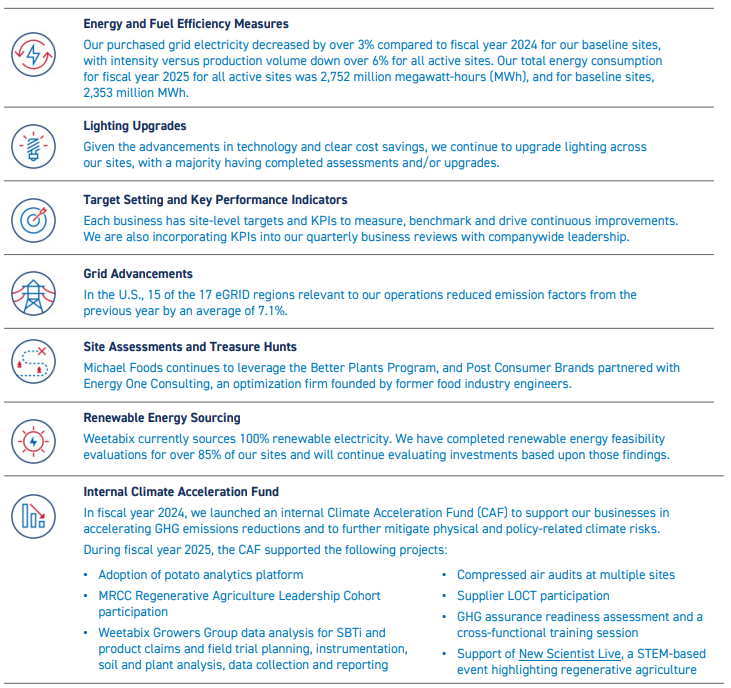
The following are key action areas deployed across our businesses during fiscal years 2024-2025:

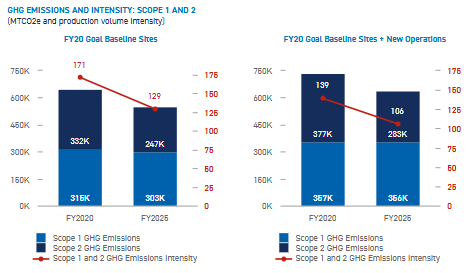
Our Progress: Compared to our fiscal year 2020 goal baseline, we have decreased scope 1 and 2 GHG absolute emissions by 15% and emissions intensity versus production volume by 25% for baseline sites.
Our most up-to-date Scope 1, 2 and 3 GHG emissions data is available here.
Our purchased grid electricity decreased by over 3% compared to fiscal year 2024 for our baseline sites, with intensity versus production volume down over 6% for all active sites. Our total energy consumption for fiscal year 2025 for all active sites was 2,752 million megawatt-hours (MWh), and for baseline sites, 2,353 million MWh.
Post is also pursuing GHG reductions and climate resiliency in our supply chain (Scope 3) with our upstream (sourcing and packaging) and downstream (transportation, logistics and retail) supply chain partners. During fiscal year 2025, we also maintained participation in various supply chain engagement-related initiatives, such as the following:
During fiscal year 2025, we again estimated our global scope 3 GHG emissions using procurement from the most recently available fiscal year (in this case, 2024) and the spend-based calculation method. Analysis using fiscal year 2025 data is currently underway and outputs will be shared on our website. The following is a graphical summary by category.
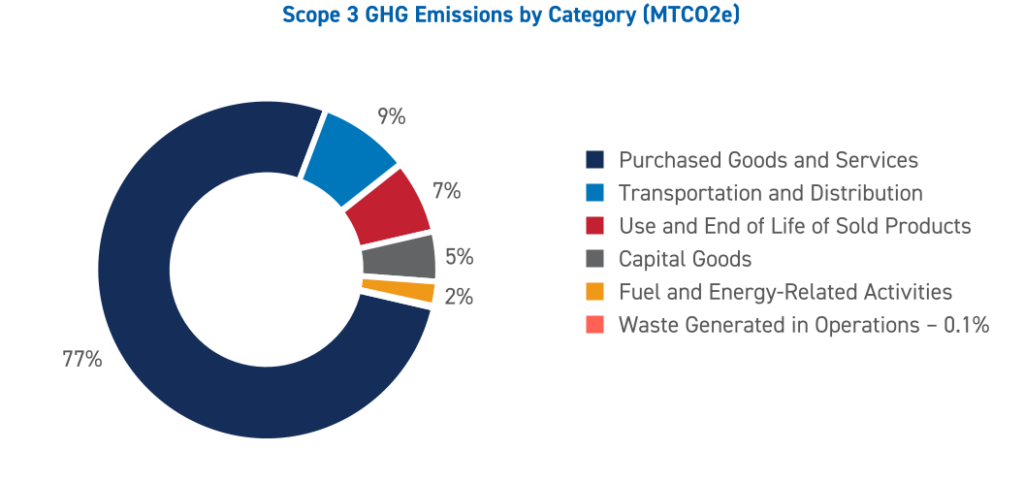
For the largest category of scope 3 GHG emissions, purchased good and services, the following sub-categories are estimated to be the largest contributors:
73% – Agricultural-based ingredients and raw materials
14% – Electricity, gas and water supply
6% – Pulp and paper, rubber, plastics
The remaining emissions are split across multiple small portion sub-categories.
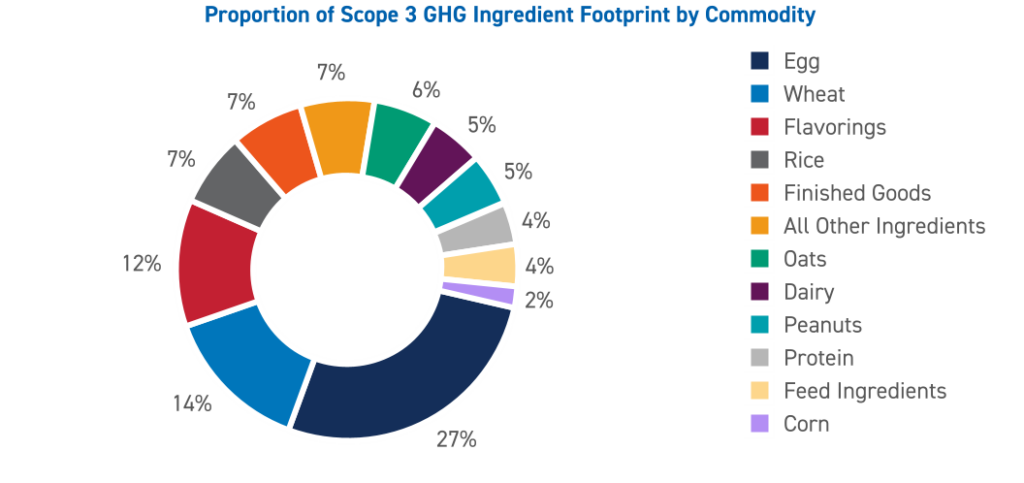
Future monitoring and measurement of scope 3 GHG emissions will utilize the HowGood platform. We have started to utilize the platform to further evaluate and profile the GHG emissions by ingredient category. The following is an initial baseline profile.
Task Force on Climate-related Financial Disclosures (TCFD)
Post is committed to demonstrating alignment with recommendations of the Task Force on Climate-related Financial Disclosures (TCFD), including an annual TCFD Disclosure, and also participates in the annual CDP Climate disclosure.
The Post Risk Management function oversees a comprehensive program to evaluate
and mitigate risks to our business, assets and people including consideration of climate-related risks and resiliency. To understand the exposure of our assets, operations and personnel to climate-related risks, we conduct annual climate scenario assessments as described in this section and also leverages the Climate Resilience Product Suite available through our global commercial property insurance partner.
The combined insight from the assessments is utilized to validate scenario modeling, prioritize further
evaluations, develop or enhance business continuity plans, inform decisions on actions and investments
to build resiliency and where necessary implement insurance mechanisms.
Post maintains a TCFD-aligned global assessment of climate risks and opportunities with the following core elements:
- Consideration of three categories of factors based upon TCFD recommendations:
- Acute Physical Factors
- Extreme weather (avalanches/winter weather/cold waves, earthquakes, hail, hurricanes, ice storms, landslides, lightning, strong winds/tornadoes, tsunamis, volcanic activity, and wildfires)
- Inland/Riverine Floods
- Chronic Physical Factors
- Water stress (availability and quality)
- Drought / Heat waves
- Coastal Floods / Sea level rise
- Biodiversity and sensitive habitats
- Transition Factors
- Country-level (e.g., United Nations Framework Convention on Climate Change (UNFCC) Nationally Determined Contributions (NDC) Registry)
- Location-specific contextual data from various sources (e.g., energy mix, utility renewable energy targets, net metering status, and carbon pricing mechanisms)
- Acute Physical Factors
- Evaluation of all global operational locations using leading external datasets.
- Completion of a Facility Climate Risk Applicability Survey by all global production locations.
- Consolidation of data into an analysis tool.
- Implementation of risk mitigation actions. In addition to the actions defined above, we have also implemented over 25 physical and human element projects at global sites over the past four years to build climate resiliency ranging from updating plans and guidelines (e.g., snow monitoring and response) to physical site improvements (e.g., roof maintenance, reinforcement and structural analysis).
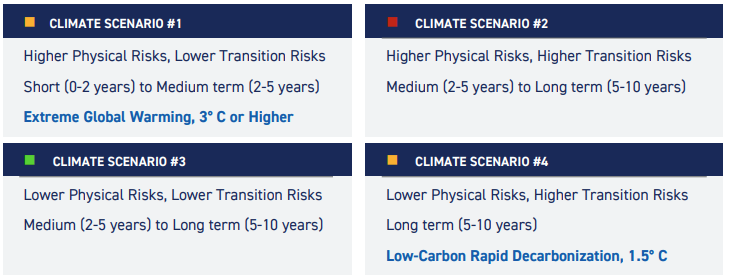
Post also annually evaluates our global ingredient and packaging suppliers and third-party warehouse and distribution sites following a similar four-scenario method and also an evaluation of proximity to water stressed regions, areas of high biodiversity and deforestation.
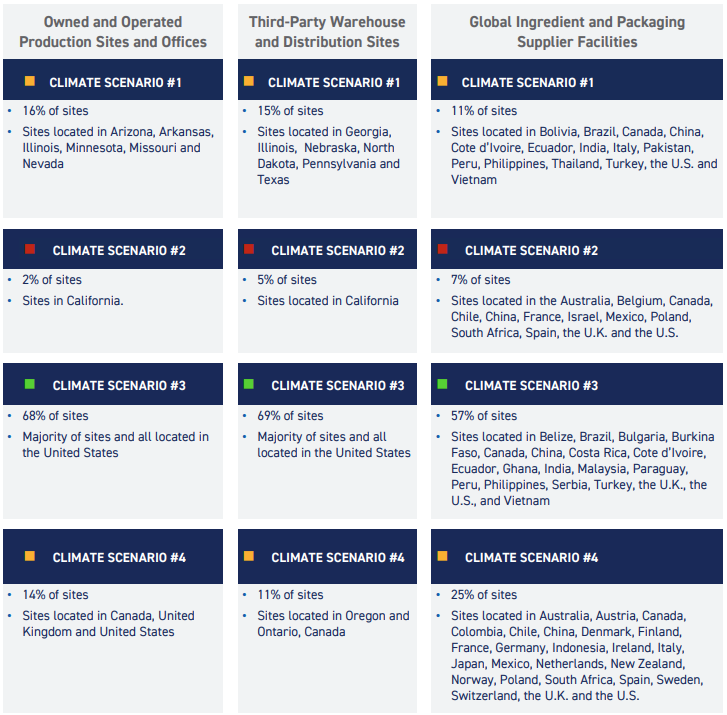
Additional detail on these assessments is available on the following pages: Water Stewardship and Biodiversity and Deforestation.